

Why Your Tests Should Run in Parallel

Sequential tests are a quiet tax most teams pay. When tests can't run in parallel, it's not an infrastructure problem—it's a design problem. Learn why parallel-ready tests are better engineered and how AI can make them the default.
Most engineering teams pay a quiet tax: their end-to-end tests run sequentially.
It starts small—a few tests, a few minutes. But as your product grows, your test suite balloons from minutes to hours. A single red build blocks the org, and a "quick deploy" becomes a 2-hour ordeal.
The root cause? Tests that depend on each other.
Sequential Tests Are a Symptom of a Deeper Problem
When tests can't run in parallel, it's rarely infrastructure—it's test dependencies.
Test B assumes Test A created a user. Test C uses data mutated by Test B. Test D fails if Test A left the system in a weird state.
This accidental complexity makes tests brittle, slow, impossible to scale, and ultimately untrustworthy.
If your test suite can't run in parallel, it's telling you something:
👉 Your tests are reflecting the statefulness of your product, not the intent of your product.
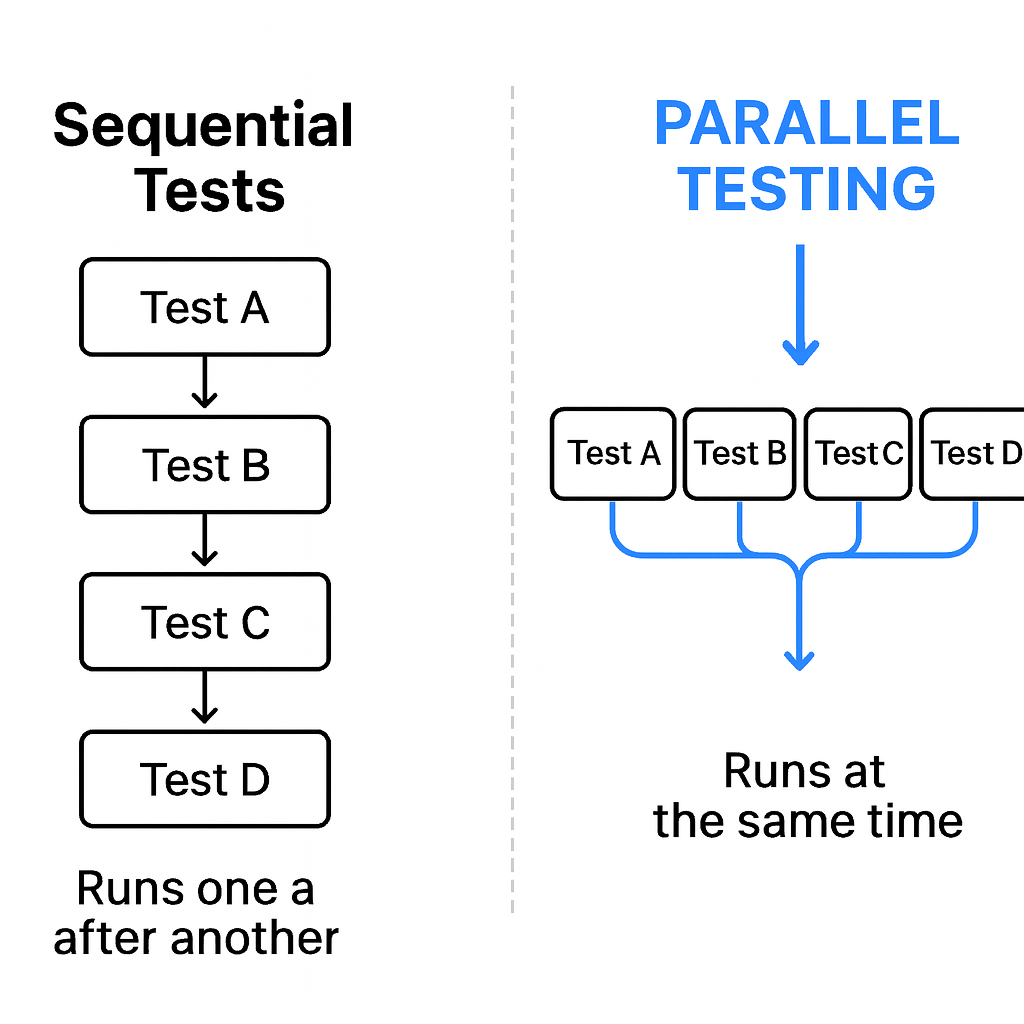
Parallel-Ready Tests Share Three Traits
Tests that run in parallel aren't just "faster." They're better engineered.
They follow a few foundational principles:
1. They are idempotent
Running them once or running them 10 times should lead to the same outcome.
No global state. No leftover users. No "cleanup scripts."
2. They have zero inter-dependencies
A test's setup and teardown live within the test.
It doesn't assume some earlier test "set things up."
Every test should stand alone.
3. They are designed for maximum parallelism
Great tests expect to run next to dozens of others.
They isolate data. They isolate sessions.
They don't pollute shared environments.
When you follow these principles, something magical happens:
You get predictability and speed without extra infrastructure or heroics.
Most Teams Know This—Very Few Actually Do It
Teams want parallel tests.
But building tests this way—especially manually—is hard.
It requires discipline, conventions, and a deep understanding of the product's behavior.
That's where AI gives teams a new superpower.
How Stably Makes Parallel Testing the Default
Every user of Stably's Test Creation Agent gets parallel-ready tests automatically.
By design, our agent generates tests that follow these best practices every single time:
1. Idempotent by default
The agent creates and cleans up its own data, and uses deterministic selectors and actions.
2. No inter-dependencies
Each test is a fully self-contained flow.
If you delete all other tests, this one still runs perfectly.
3. Maximum parallel execution
The agent avoids global shared state, designs unique fixtures, and ensures tests can safely run side-by-side.
This is one of those invisible benefits.
You don't notice it at first… until you run your suite on a 16-core machine and watch a 10-minute suite finish in 40 seconds.
Parallel Tests Aren't Just a Speed Boost—They're a Cultural Shift
Running tests in parallel forces clarity:
- Every test becomes explicit
- Every outcome becomes deterministic
- Every suite becomes stable
- And your CI stops being a bottleneck
This is the quiet foundation of a high-velocity engineering org.
If you want reliability and speed, parallel testing isn't optional—it's the default.